Region guide
Southwest Finland
Finland’s former capital, Turku, and a wide archipelago that already feels like a sea voyage.
Updated 22.11.2026 (Europe/Helsinki). Turku · Egentliga Finland
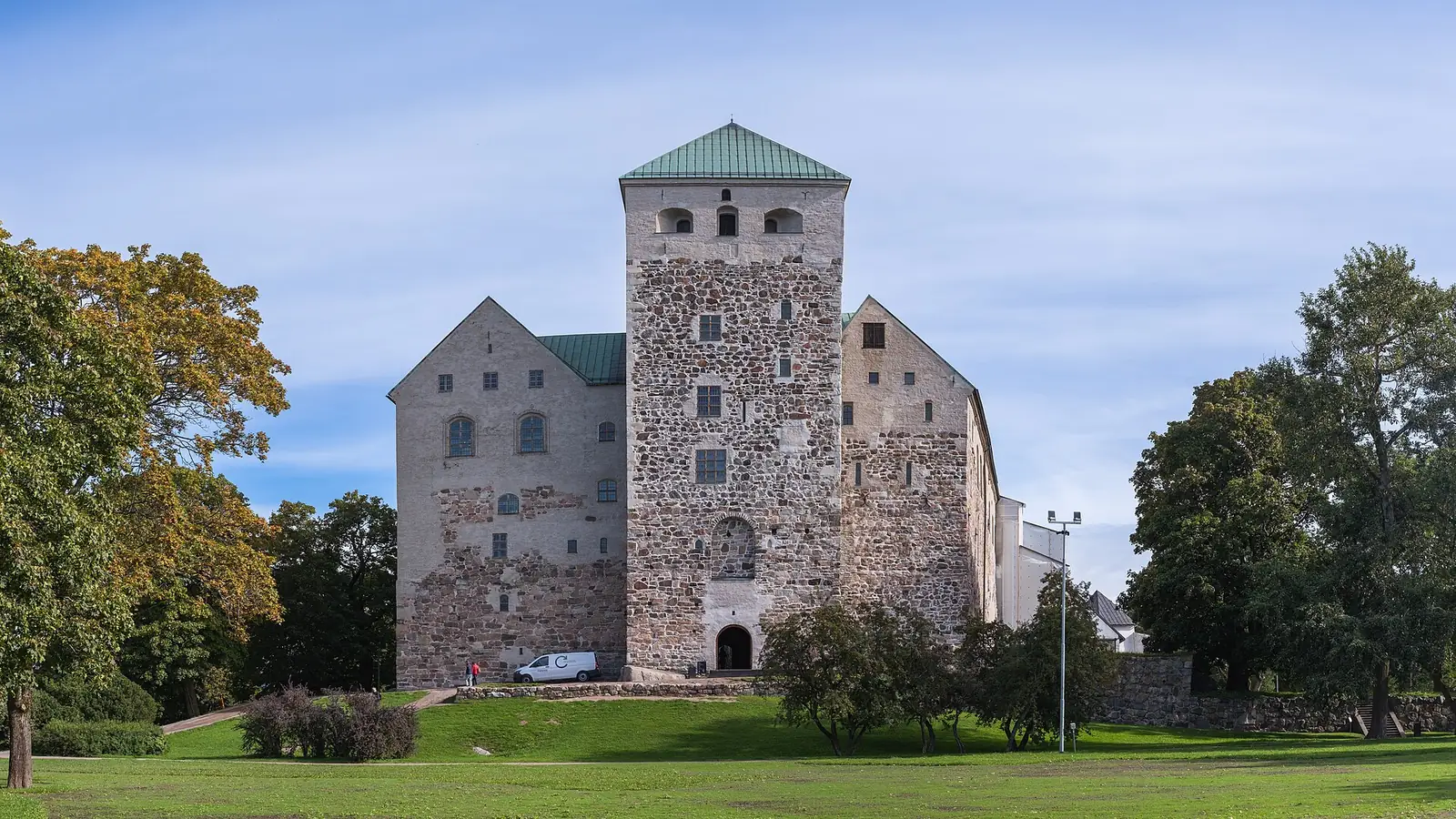
Photo: Christian David / Wikimedia Commons (CC BY-SA 4.0)
Highlights
- Turku Castle and the Aura riverfront.
- The Turku archipelago, with bridges, ferries and cycling routes.
- Naantali’s old town and harbour, a short trip from Turku.
- Ferries onward to Åland and Sweden.
Planning the trip and the best season
June to August is the usual season for the archipelago. May and September can be clear and quieter, but some island services thin out.
Month-by-month weather, Kaarina Yltöinen (near Turku)
Normal period 1991–2020. Temperatures are monthly means, not average daily highs.
| Month | Mean temperature | Rain or snow | Note |
|---|---|---|---|
| January | -3.6 °C | Moderate54 mm | |
| February | -4.3 °C | Moderate41 mm | |
| March | -1.3 °C | Low37 mm | |
| April | 4.0 °C | Low32 mm | |
| May | 10.0 °C | Low35 mm | |
| June | 14.5 °C | Moderate57 mm | |
| July | 17.5 °C | Wet71 mm | |
| August | 16.2 °C | Wet78 mm | |
| September | 11.5 °C | Moderate56 mm | |
| October | 6.0 °C | Wet74 mm | |
| November | 1.9 °C | Moderate67 mm | |
| December | -1.3 °C | Moderate68 mm |
Months marked with a gold line are, on this page, the more comfortable window for a general visit. Northern lights, skiing or the midnight sun may favour different months.
Source: FMI monthly climate pages, 1991–2020 normals, checked 22.11.2026. https://www.ilmatieteenlaitos.fi/tammikuu
How to get there and get around
Turku Airport has mainly domestic and some European flights. From Helsinki, VR trains take a little under two hours on typical schedules (check VR for the current timetable). Coaches also run frequently. Archipelago travel combines buses, yellow ferries and, in places, your own bike or car. Book ferry slots in high summer.
Turku Airport (TKU)
Booking or tour links opened later will be marked like this: [AFFILIATE].
Where to stay
Towns have hotels, apartments and hostels; lake and coastal areas also have cottages and campsites. Lapland additionally offers glass cabins and wilderness stays, and Åland has small guesthouses. We do not list prices or recommend individual businesses, because those change quickly.
Compare places to stay in current booking services. If we later add a partner link from this site, it will be marked clearly: [AFFILIATE].
Living there and cost of living
Rents below are Statistics Finland’s average monthly rents per square metre for non-subsidised dwellings in the third quarter of 2026 (table 15fa, updated 15 October 2026). They describe existing contracts, not a particular listing. The rate for new contracts is in its own column where it was published.
| Area | Average rent | New contracts |
|---|---|---|
| Turku | €15.64 /m² | €15.69 /m² |
| Turku, studio | €19.59 /m² | €20.15 /m² |
| Region average | €14.66 /m² | €14.89 /m² |
| Whole country (excl. Åland) | €15.99 /m² | €16.72 /m² |
| Finland excl. Greater Helsinki | €13.91 /m² | €14.30 /m² |
Illustration only, not a listing: a 50 m² flat at the average rate of €15.64/m² would come to about €782 a month. Individual homes differ a good deal.
Grocery prices usually vary less than rents, because national supermarket groups operate widely. There was no separate Numbeo grocery basket for this town that we could cite on 22.11.2026. For comparison, in Helsinki (Numbeo, updated 20.11.2026) milk 1 l was €1.24 and eggs (12) were €3.42. Treat this only as a rough national-market illustration. Source: Numbeo, Helsinki.
Rent source: Statistics Finland, StatFin 15fa, non-subsidised dwellings, 2026Q3, checked 22.11.2026.
Local food
Coastal fish, archipelago bread and, in summer, new potatoes appear on many menus. Turku has student-town cafés and restaurants. Swedish-language menus are more common here than inland.
Nature and activities
This is one of the classic places for a first Finnish sauna-and-sea swim in summer. The archipelago is low and rocky rather than alpine. Winters are milder than inland, but still icy.
Money and payments
Finland’s currency is the euro. Cards and contactless payments are widely accepted in shops, restaurants, transport and many machines. Cash is used less than in many countries, but a little euro cash is still useful in some markets or if a terminal is down.
MobilePay is popular with residents, but a visitor should not assume it will work without a supported account. Cash machines are available in towns. There is usually no need to change large amounts of cash in advance. Tipping is not expected; you may round up for good service if you wish.
Wines and spirits are sold mainly through the Alko network; supermarket ranges are more limited. On Åland and on some ferry routes the tax treatment can differ from mainland Finland — check before you buy.
This is general information, not banking or tax advice. Confirm payment methods on the spot.
Doctors, pharmacies and the medicines you bring
The emergency number throughout Finland is 112. The free 112 Suomi app helps with location. Municipal health centres mainly serve people who live in the area; emergency departments treat everyone in an acute situation. On a short trip, visitors usually use a private clinic or emergency care and pay unless travel insurance covers the visit. If you are insured in an EU or EEA country or Switzerland, bring a European Health Insurance Card (EHIC) or equivalent. It does not replace travel insurance.
In Turku and other towns in the region you will find pharmacies in the centre and in shopping areas. Prescription medicines can be dispensed on a Finnish electronic prescription and, under certain conditions, on a prescription issued in another EU or EEA country or Switzerland if the medicine is available in Finland. Ask for an EU cross-border prescription before you leave home. A prescription written outside the EU, the EEA or Switzerland is generally not valid in Finland.
According to Fimea and Finnish Customs (checked 22.11.2026), you may bring medicines for personal use: up to a one-year supply if you carry them from an EEA country, and up to a three-month supply from outside the EEA. Carry a prescription or medical certificate for prescription medicines. Stricter limits apply to medicines classified as narcotics; in the Schengen area you often need a Schengen certificate. You may not have medicines sent by post from outside the EEA. Keep medicines in their original packaging in your hand luggage.
This is not medical or customs advice. Check how your product is classified in Finland in Fimea’s medicine search and, for long-term medicines, with your own doctor and if needed a Finnish mission.
Sources: Fimea, Travellers’ medicines; Finnish Customs; EU-healthcare.fi; emergency number 112.
Practical safety
Finland is a safe country in international comparison, but ordinary caution still applies. The emergency number is 112. In winter the main risks are darkness, ice underfoot and thin lake or sea ice; in summer, check the forecast and life jackets before going out on the water. Elk and reindeer cross roads, especially at dusk. Ticks are more common in the south and on the coast; the Finnish Institute for Health and Welfare (THL) advises on regional risk and vaccines such as tick-borne encephalitis.
Everyman’s right allows walking in nature, picking berries and short-term camping under certain conditions, but yards, fields and rules in protected areas must be respected. Winter tyres are required in winter conditions. In the outer islands, shops and cash machines are sparse. Check the last ferry of the day.
Sources and uncertain points
- Visit Finland, practical tips and northern lights guidance, checked 22.11.2026. visitfinland.com
- Finnish Meteorological Institute monthly climate pages and Wikipedia tables that cite FMI 1991–2020 (or an older period where flagged). ilmatieteenlaitos.fi
- Statistics Finland, rents of dwellings, StatFin 15fa, 2026Q3, updated 15.10.2026.
- Fimea and Finnish Customs on travellers’ medicines; 112; EU-healthcare.fi on cross-border prescriptions.
- VR and Finavia / Finnair should be checked for current times and routes. We do not invent timetables.
Uncertain points are flagged in the weather and cost sections where a station, period or source chain is mixed.